


2026 Shelley 40th Anniversary Weekend
(Uploaded 19/06/26)
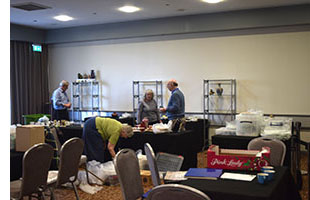 On Friday morning a group of early arrivals for the weekend celebrations enjoyed a guided tour of Middleport Pottery. The working Burleigh Factory allows you to see production from clay to cup using traditional methods of manufacture and one visitor said it made it much easier to understand production terms. Some then went on to lunch at the home of Northern member Paul Graetz while back at the hotel displays were set up.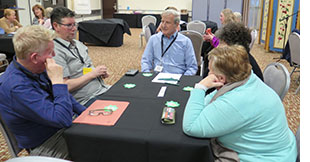
After the official registrationthe Friday evening quiz had six teams vying for top spot answering questions set by Olwen Dudgeon. Food, a picture identification covering the 40 years of the group’s existence and a guess the link between three items of Shelley or Wileman. After, a lot of groaning and scratching heads the chocolates prize was won by the Gainsborough team.
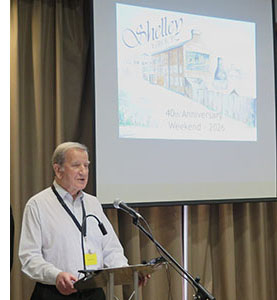
Saturday morning events began with the playing of “Congratulations” and the bang of party popper streamers signalling the Group’s Ruby celebrations. Chairman Gerry Pearce welcomed overseas visitors including Therese Healey, president of the Australasian Club and Lynn Porrazzo, President of the USA National Shelley Club. He thanked the Committee for all their hard work organising everything for the 40th celebrations.
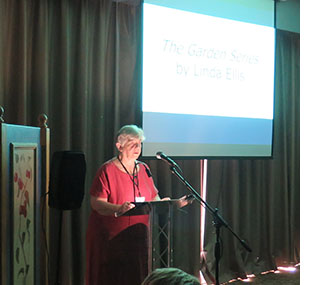
The first talk was by Linda Ellis describing the Garden series designed by Eric Slater. She pointed out it was 100 years ago in August 1926 that Shelley registered the new Queen Anne shape, which went on to have hundreds of different patterns. They included a new series in 1928 after it is thought, the designer had visited London at the time of a Buckingham Palace garden party. These included the very popular Archway of Roses, Garden Urn and a number of cottage scenes some of which also appeared on other shapes including Georgian, Vincent and Doric.
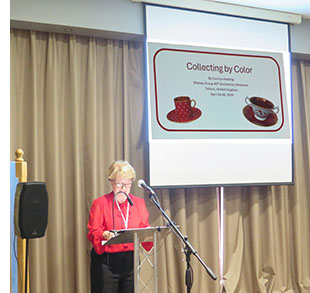
Next was Carolyn Keating, 'Collecting by Color', aptly describing her ruby and gold collection. Brian Hill had cleverly picked a piece of music to launch each speaker and hers was 'Ruby Tuesday'. Her sumptuous selection included beautiful Micklewright cabinet plates, polka dot mochas, Sgraffito coffee sets, Wileman on Daisy, Bramble chintz and fruit on Henley.
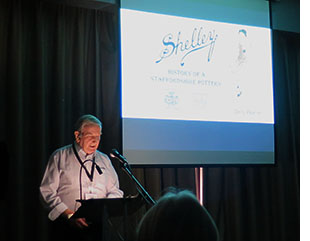 Gerry Pearce followed with an extensive history of the Shelley Pottery beginning on a sad note when he pointed out that in the year our group celebrates 40 years, in August it will be 60 years exactly since the factory closed in 1966.
Beginning in 1872 when James Wileman took Joseph Ball Shelley into partnership he took us through important events ranging from Victoria being the earliest cup shape recorded in surviving pattern books, to the fact that 143 Japan patterns were produced between 1884 to 1935.
By the early 1890s more delicate, fluted and scalloped shapes were in production such as Daisy, Fairy, Lily, Albert and Empire and the export market had become increasingly important. By 1896 they had agents in Australia, USA and Canada and a showroom in London. Shelley’s longest running design Dainty was introduced in 1896 and stayed in production until the factory closed.The importance of Frederick Rhead, the development of Faience, Spano-Lustra and Intarsio, the introduction of miniatures both crested and decorative, the growth in breweriana were among topics covered before Walter Slater took over as arts director and changes in backstamp followed. By 1919 Walter’s son
Gerry Pearce followed with an extensive history of the Shelley Pottery beginning on a sad note when he pointed out that in the year our group celebrates 40 years, in August it will be 60 years exactly since the factory closed in 1966.
Beginning in 1872 when James Wileman took Joseph Ball Shelley into partnership he took us through important events ranging from Victoria being the earliest cup shape recorded in surviving pattern books, to the fact that 143 Japan patterns were produced between 1884 to 1935.
By the early 1890s more delicate, fluted and scalloped shapes were in production such as Daisy, Fairy, Lily, Albert and Empire and the export market had become increasingly important. By 1896 they had agents in Australia, USA and Canada and a showroom in London. Shelley’s longest running design Dainty was introduced in 1896 and stayed in production until the factory closed.The importance of Frederick Rhead, the development of Faience, Spano-Lustra and Intarsio, the introduction of miniatures both crested and decorative, the growth in breweriana were among topics covered before Walter Slater took over as arts director and changes in backstamp followed. By 1919 Walter’s son 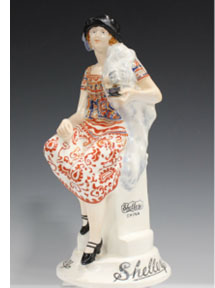 Eric joined the company in time for the Jazz age as vases and other decorative earthenware took on a riot of colour. Cup shapes included Queen Anne, despite being difficult to drink from it proved immensely popular with more than 560 patterns. Collaboration on advertising between Shelley and Smedley Services saw the elegant Shelley girl being sent out to china dealers while the Shelley Standard carried the message it was stylish to use Shelley. Vogue, Mode, Eve and Regent followed while Walter concentrated on beautiful lustre decorations.
Nursery ware designed by Hilda Cowham and Mabel Lucie Attwell were launched before the company became Shelley Potteries Ltd with Percy Shelley and his three sons being equal shareholders. The company was successful through the thirties until war was declared in 1939. Although production continued production of earthenware ended and in 1942 china for home consumption was limited to white ware.After the war another generation of the Shelley family joined the firm, with Vincent Bob’s sons Alan and Donald and in 1949 Ray Reynolds followed initially as Assisting Decorating manager, fortunately for us later saving the pattern books. Avon was Shelley’s last cup shape, introduced in 1964, two years before Shelley China Ltd was taken over by Allied English Potteries.
Next was Olwen Dudgeon on covered boxes or as she prefers to call them powder bowls. Illustrated with pictures of round and octagonal examples as well as specials such as Hilda Cowham and fruit lids, she described how they fell out of popularity. Partly because of the development of powder compacts for handbags, partly being replaced by pretty tins of talcum powder, but also because harmful chemicals were found in some earlier brands.
After lunch guest speaker Mark Hill described Curves, Colours and Cool, as his introduction to mid-century modern items. He spoke enthusiastically of developments in the 1950s, 1960s and 1970s to produce new affordable and stylish designs. He split them into four main areas, Scandinavian, Italian, American and British which he became interested in from his earl
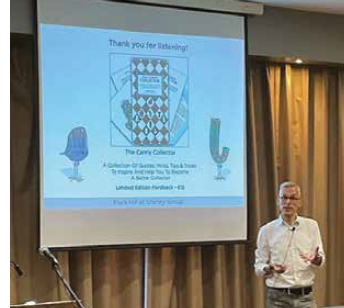 y days as a junior cataloguer and porter at Bonhams Auctioneers. Scandinavian designs followed nature avoiding straight lines, curving for comfort such as the Egg chair an icon of mid-century modern. Stig Lindberg was one of the most important post war designers in several areas including glass and ceramics. In Italy Aldo Londo created exceptional work for ceramics manufacturer Bitossi including Rimini Blue, while Murano glass revolutionised the way glassware, with Sommerso vases the opposite of Victorian frills and fuss.
An influx of immigrants to America after the Second World War saw a diversity of influences from different areas of Europe. Mark described a liking for comfort running through new designs such as those of husband and wife Charles and Ray Eames known for their groundbreaking contributions to architecture, furniture and industrial design.In Britain trendy items for sale included Ridgway’s Homemaker pottery, Whitefriars vases, Zambezi china by Midwinter and Ercol furniture while Terence Conran was revolutionising home style at Habitat. As part of the weekend celebrations Chairman Gerry Pearce had prepared a rolling video presentation on the history of the Shelley Group with lots of old familiar faces and events to view.
y days as a junior cataloguer and porter at Bonhams Auctioneers. Scandinavian designs followed nature avoiding straight lines, curving for comfort such as the Egg chair an icon of mid-century modern. Stig Lindberg was one of the most important post war designers in several areas including glass and ceramics. In Italy Aldo Londo created exceptional work for ceramics manufacturer Bitossi including Rimini Blue, while Murano glass revolutionised the way glassware, with Sommerso vases the opposite of Victorian frills and fuss.
An influx of immigrants to America after the Second World War saw a diversity of influences from different areas of Europe. Mark described a liking for comfort running through new designs such as those of husband and wife Charles and Ray Eames known for their groundbreaking contributions to architecture, furniture and industrial design.In Britain trendy items for sale included Ridgway’s Homemaker pottery, Whitefriars vases, Zambezi china by Midwinter and Ercol furniture while Terence Conran was revolutionising home style at Habitat. As part of the weekend celebrations Chairman Gerry Pearce had prepared a rolling video presentation on the history of the Shelley Group with lots of old familiar faces and events to view. 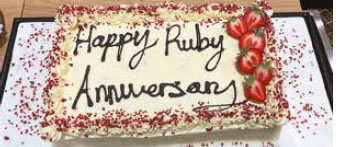
The hotel had produced a red velvet cake for the attendees to enjoy with their afternoon tea.
Chris Davenport had also set up tables of special exhibits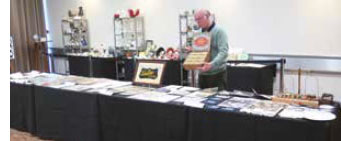 relating to the company which he went through as the last afternoon event.These included fascinating examples of original artwork often on cardboard and odd bits of paper, sometimes for cup shapes or vases that never went into
production and a selection of photographs including girls in the decorating shop. Other items ranged from the stamp used to cancel designs in the pattern books to cardboard signs and cutouts used in displays.The silent auction had its usual wide range of items for sale.
relating to the company which he went through as the last afternoon event.These included fascinating examples of original artwork often on cardboard and odd bits of paper, sometimes for cup shapes or vases that never went into
production and a selection of photographs including girls in the decorating shop. Other items ranged from the stamp used to cancel designs in the pattern books to cardboard signs and cutouts used in displays.The silent auction had its usual wide range of items for sale.
Then it was the Gala dinner with everyone encouraged to wear something red. Surprise gifts during the event included a specially made Ruby anniversary Shelley plaque and a lucky dip draw for all sorts of Shelley and Wileman goodies.
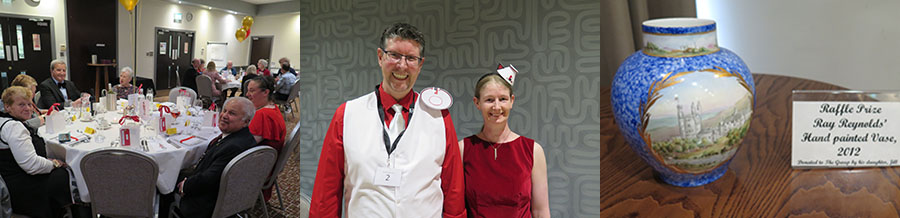
Justin and Louise also received a bonus surprise as the best dressed Ruby diners with their special outfits including his beautifully created Vogue waistcoat and hat. A presentation was also made to Carole Lockyer for all her work for the Group having stood down from the committee at the AGM.
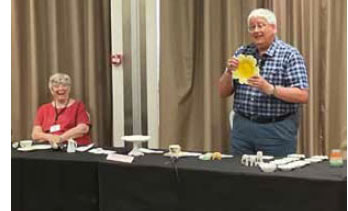
Sunday began with the Shelley snake, this year on “the piece that means most to you.” John Barter began with his first Harmony purchase when he was 24, Brian Hill had a family story about his Dainty comport, while Carmen Kliendienst had a special bear and terrapin as well as a Cromer crested crab brought all the way from Australia. Other items ranged from a little brown jug to a rare Charlie Chaplin, an early purchase of art pottery to a Vogue meat plate.
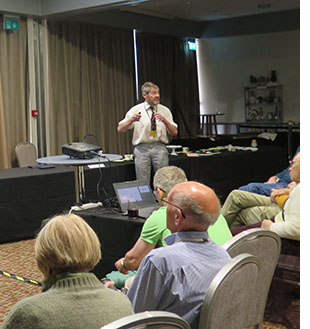
Next was an amusing presentation by Paul Graetz on The Crested World Seen Through Shell’eyes opening with an appropriate pair of binoculars.He described a day in the Shelley home covering ironing, reading going outside into the garden with a sundial, a wheelbarrow and a tennis racket. In the drawing room there were matches and a pipe, a soda siphon, a beer bottle and a piano and banjo for entertainment. A candle lit the way to bed and nine months later there was a cradle.There was Shelley on the move with a bus trip, boating and Blackpool tower. On a trip to Scotland there was the Forth Railway Bridge and Robert Burns. Finally there was a Shelley alphabet with some clever thinking on difficult letters.
The final talk of the weekend was by Chris Davenport on Frederick Alfred Rhead: His Influence and Inspiration. He took us through his family and early working life starting at Minton’s at only 13. He won prizes for art pottery design and learnt the decorative technique of
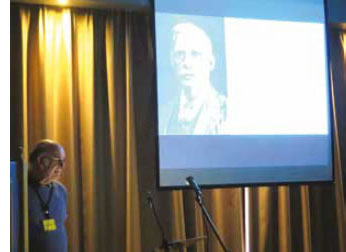 pate-sur-pate under French ceramist Marc Louis Solon before he was dismissed and went to work for Wedgwood.He then moved on to further factories, while at Bodley’s producing the Gladstone vase commissioned by Burslem Liberals. In 1896 Rhead became Art Director at Wileman & Co where he made his most significant contribution to the industry. His experimental work with earthenware produced Spano-Lustra, Urbato, Primitif, Pastello and of course Intarsio. He saw no reason why mass-produced pieces could not be created with an artistic merit of their own.
Patterns featured Art Nouveau flower motifs, fish, farmyard animals, Egyptian motifs and characters from Shakespeare. Boosting Wileman’s reputation and attracting commissions from Liberty’s of London.Around the turn of the century, he visited Holland and turned sketches into new designs including Dutch children on nursery ware and a series of sailing boats and windmills. Around 1900 he started a new process producing tube-lined ware.Chris also described the life of his six children, four of whom followed him into the pottery industry including Charlotte. Frederick Rhead left Wileman in 1905; three years later he was a partner in his own tile manufacturing firm until that enterprise failed. He then travelled to the USA where he worked with his son for a few months before returning home. In early 1913 he joined Wood & Sons as the Art Director, a position he held until 1929, before moving to Cauldon Potteries. He died in 1933. In one obituary he was described as “The Leonardo da Vinci of North Staffordshire.”
pate-sur-pate under French ceramist Marc Louis Solon before he was dismissed and went to work for Wedgwood.He then moved on to further factories, while at Bodley’s producing the Gladstone vase commissioned by Burslem Liberals. In 1896 Rhead became Art Director at Wileman & Co where he made his most significant contribution to the industry. His experimental work with earthenware produced Spano-Lustra, Urbato, Primitif, Pastello and of course Intarsio. He saw no reason why mass-produced pieces could not be created with an artistic merit of their own.
Patterns featured Art Nouveau flower motifs, fish, farmyard animals, Egyptian motifs and characters from Shakespeare. Boosting Wileman’s reputation and attracting commissions from Liberty’s of London.Around the turn of the century, he visited Holland and turned sketches into new designs including Dutch children on nursery ware and a series of sailing boats and windmills. Around 1900 he started a new process producing tube-lined ware.Chris also described the life of his six children, four of whom followed him into the pottery industry including Charlotte. Frederick Rhead left Wileman in 1905; three years later he was a partner in his own tile manufacturing firm until that enterprise failed. He then travelled to the USA where he worked with his son for a few months before returning home. In early 1913 he joined Wood & Sons as the Art Director, a position he held until 1929, before moving to Cauldon Potteries. He died in 1933. In one obituary he was described as “The Leonardo da Vinci of North Staffordshire.”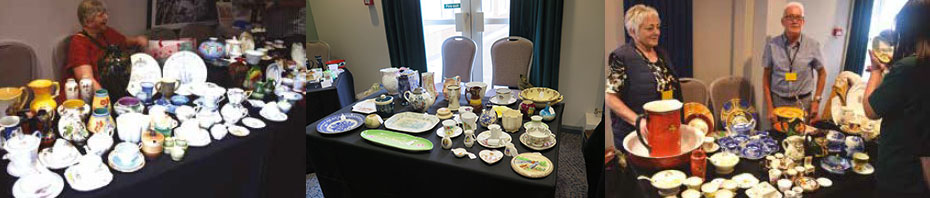
There was a huge variety of items on offer at the Shelley market ranging from trios to Toby Jugs, pin dishes to vases. After lunch it was time to pack up the displays while some of those staying on another night enjoyed an afternoon trip to the 16th century Benthall Hall.